
Koryx Copper Announces Further Drill Results at the Haib Copper Project in Southern Namibia
Highlights
- Assay results reported for 15 drill holes comprising 6,825m of infill and expansion drilling.
- Consistent, wide intercepts incl. 318m @ 0.49% CuEq (162 – 480m) and 220m @ 0.40% CuEq (32-252m) with higher grades across multiple holes (incl. 12m @ 2.55% CuEq (from surface), 10m @ 1.78% CuEq and 32m @ 1.06% (from 224m)) - among the best grades drilled at Haib to date.
- Best 6 of 15 drill hole assay intersections as follows:
|
• HM178: |
669m @ 0.33% CuEq (53ppm Mo, 0.027g/t Au) (0 – 669m) | ||
| incl. | 318m @ 0.49% CuEq (162 – 480m) | ||
|
• HM180: |
732m @ 0.30% CuEq (84ppm Mo, 0.023g/t Au) (0 – 732m) | ||
| incl. | 286m @ 0.37% CuEq (446 – 732m) | ||
| and | 10m @ 0.45% CuEq (48 – 58m) | ||
| and | 20m @ 0.42% CuEq (96 – 116m) | ||
| and | 26m @ 0.61% CuEq (136 – 162m) | ||
|
• HMRC009: |
642m @ 0.30% CuEq (96ppm Mo, 0.018g/t Au) (0 – 642m) | ||
| incl. | 108m @ 0.40% CuEq (302 – 410m) | ||
| and | 49m @ 0.42% CuEq (249 – 298m) | ||
|
• HMRC008: |
558m @ 0.29% CuEq (22ppm Mo, 0.024g/t Au) (0 – 558m) | ||
| incl. | 14m @ 0.59% CuEq (246 – 260m) | ||
|
• HM158: |
609m @ 0.29% CuEq (61ppm Mo, 0.009g/t Au) (0 – 609m) | ||
| incl. | 374m @ 0.34% CuEq (0 – 374m) | ||
|
• HM179: |
261m @ 0.27% CuEq (16ppm Mo, 0.040g/t Au) (0 – 261m) | ||
| incl. | 32m @ 1.06% CuEq (224 – 256m) | ||
LUXEMBOURG, Sept. 09, 2026 (GLOBE NEWSWIRE) -- Koryx Copper S.A. (TSX:KRY.V) (NSX:KYX) (OTCQX:KRYXF) (“Koryx” or the "Company") is pleased to announce assay results from 15 drill holes (6,825m) received as part of the ongoing infill and expansion drill program on the wholly-owned Haib Copper Project (“Haib” or the “Project”) in southern Namibia.
Haib is a massive, disseminated porphyry Cu/Mo/Au deposit and is envisaged to produce a Cu and Mo concentrate via large-scale open pit mining and conventional sulphide milling and flotation.
Heye Daun, Koryx Copper’s President & CEO commented: “We continue to receive excellent drill assay results from our PFS infill drill program which has recently concluded. Once again, most of the drill results display very wide intercepts, including some high grades from surface. Whilst drilling has completed, assay results are still coming in and further results are expected in the next few weeks. The geological modelling and estimation for the updated MRE and PFS has commenced and we are on track to publish an MRE update and PFS study results before the end of 2026. We are very excited about how the PFS technical work is unfolding and we expect the PFS to describe a significantly optimized and improved project scope with corresponding improvements in the technical and economic metrics of the Haib copper project.”
Infill and Expansion Drill Results
Target Area 2:
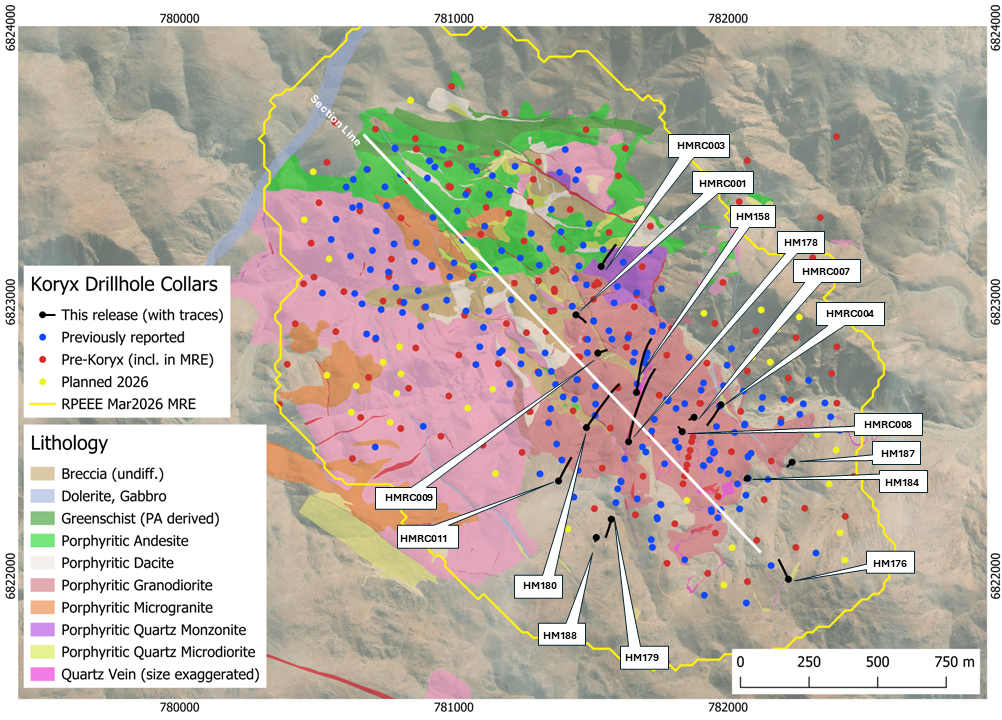
Figure 1: Plan view indicating recent drill hole locations. Results indicated in black are shown on the long section below
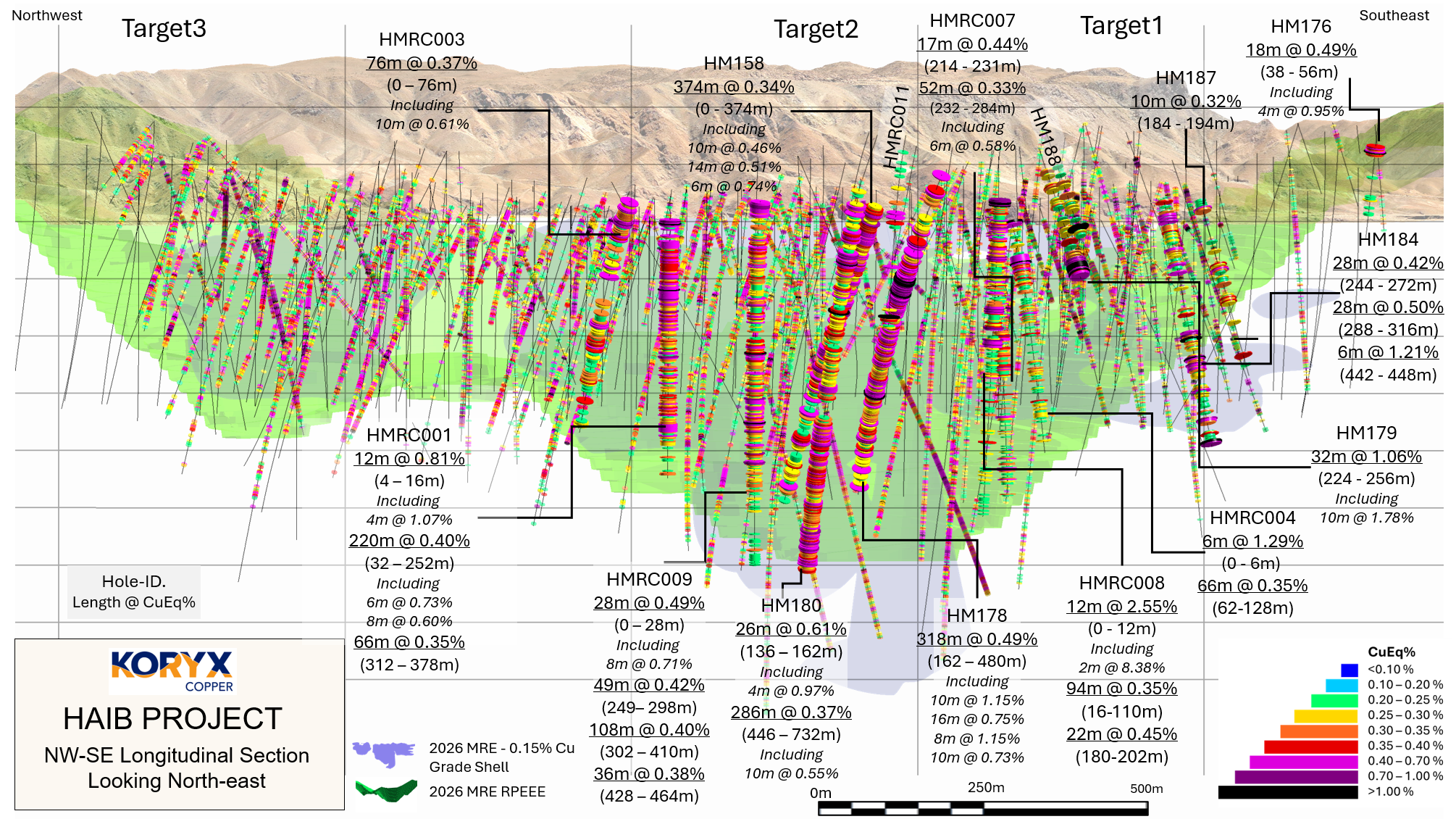
Figure 2. Long section showing fifteen drillhole intersections relative to the model for CuEq% Intercepts
Target Area 1
HM176 was drilled in the southeast of Target 1, outside the main mineralisation. While generally a lower-tenor hole, it delivered a near-surface hit of 18m @ 0.44% Cu from 38m, including 4m @ 0.87% Cu. This correlates with HM154 (previously reported), showing further eastward extension of this mineralisation. Mo grades are low, as is typical of this area.
In line with the current model, HM184 returned several stacked mineralised zones over 452m, headlined by 28m @ 0.44% Cu from 288m and 6m @ 1.12% Cu from 442m. Molybdenum grades are low but increase with depth. Tungsten is present sporadically, with one 2m interval returning 0.375% W.
HM187 is positioned on the eastern edge of Target 1 and returned only narrow, modest-grade zones, the best being 6m @ 0.36% Cu from 130m. Molybdenum is low-grade throughout.
HMRC004 is located in the north of Target 1 and correlates with the existing copper model, starting in high-grade material with 6m @ 1.27% Cu from 0m, followed by a broader 66m @ 0.31% Cu from 62m. Molybdenum is largely absent, while gold is evident, with two samples returning 0.216g/t and 0.156g/t over 2m respectively.
HMRC007 returned consistent, moderate-grade mineralisation in multiple zones from surface to depth, the widest being 52m @ 0.29% Cu from 232m, including 6m @ 0.54% Cu from 276m. As this is an infill hole, results are largely in line with expectations, although the 26m @ 0.29% Cu from 434m is some 70m vertically below the limit of the current Cu model and represents, to some extent, new mineralisation. Mo is absent, while Au is present at slightly elevated levels deeper in the borehole, providing support to the CuEq grade at depth.
HMRC008 is an infill hole showing excellent Cu mineralisation from surface, with 12m @ 2.39% Cu from surface, including 2m @ 8.01% Cu (the highest grade returned yet at Haib) from 4m. Deeper, multiple Cu zones are reported, the widest of which are 94m @ 0.32% Cu from 16m and 22m @ 0.42% Cu. W is present sporadically, the best of which is 6m @ 0.064% W.
Target Area 2
HM158 was drilled northwards from the centre of Target 2 and returned 374m @ 0.30% Cu from surface. Multiple higher-grade intervals (≥0.37% Cu) are present, varying in thickness from 4m to 14m. Results for Cu are largely as expected. Mo starts relatively low but is well developed between 60m and 300m, providing significant support to the CuEq value here.
HM178 is one of the standout holes, with a broad 318m @ 0.44% Cu from 162m, including 10m @ 0.92% Cu from 214m and 8m @ 1.06% Cu from 240m. Averaging 0.29% Cu over its full 669m, molybdenum is well developed from 160m down the hole, providing good support for the CuEq. Gold is also present, with two 4m intervals returning >0.1g/t Au. Tungsten occurs sporadically in multiple narrow zones, with grades between 0.012% and 0.022% W.
HM179 was drilled in the south of Target 2 and delivered high-grade copper only at the base of the hole: 32m @ 0.96% Cu from 224m, including 10m @ 1.65% Cu from 234m. This zone is also associated with gold, returning two 4m intervals at 0.10g/t and 0.13g/t Au, as well as 10m @ 0.18g/t Au. This is one of the highest-grade Cu and Au intersections returned yet at Haib, and its location, some 70m south of the current Cu model, points to an as-yet-undetected lobe of high-grade mineralisation, though its impact on mineral resources still needs to be determined. Mo is absent for the entire hole.
HM180 is an infill hole that was oriented to intersect the deepest parts of known Target 2 mineralisation, which it has done, correlating well with the existing copper model. Within the first 160m, Cu grades are high, with multiple zones at about 0.4% Cu and higher, the best of which is 26m @ 0.55% Cu. The widest intersection, 286m @ 0.31% Cu from 446m, is associated with high-grade molybdenum (starting at ~160m), which materially enhances the CuEq grade. Tungsten is present throughout, with the best interval being 8m @ 0.211% W.
HM188 was drilled south of known mineralisation to better define the margin of mineralisation and returned no significant intersections of copper, molybdenum, or gold. However, between 150m and 200m, tungsten is quite common, with the best return being 8m @ 0.116% W.
HMRC001 is located in the centre of Target 2 and intersected mineralisation from surface, with 12m @ 0.74% Cu from near surface, including 4m @ 0.98% Cu. The widest intersection, 220m @ 0.35% Cu from 32m, contains multiple intervals at ~0.4% Cu and higher, along with relatively high molybdenum grades. Overall, copper results correlate well with the existing model. Tungsten is present sporadically throughout, with the best interval returned being 12m @ 0.017% W.
HMRC003 is an infill hole located near the northern boundary of Target 2. It opened with 76m @ 0.33% Cu from surface, including 10m @ 0.58% Cu from 36m. Overall, results are in line with the current model.
HMRC009 is a centrally located borehole that intersected multiple broad zones over its length, the widest of which were 108m @ 0.34% Cu from 302m and 49m @ 0.37% Cu, including 4m @ 1.08% Cu. Molybdenum is well developed throughout, bolstering the CuEq grade.
HMRC011 is located south of the known Target 2 mineralisation. Results show this hole to be weakly mineralised with respect to Cu. The intersection of 8m @ 0.41% Cu from 324m (with Mo @ 221ppm) is still well south of Target 2 and may represent a peripheral, mineralised, cross-cutting structure.
Table of Significant Intersections
| Hole# | Zone | From (m) | To (m) | Width (m)1 | Cu (%) | Mo (ppm) | Au (g/t) | CuEq (%)2 |
| HM158 | X: 781666, Y 6822670, Z: 429, Azimuth: 015, Dip: -61, Depth 610 | |||||||
|
HM158 |
Entire Hole | 0 | 609 | 609 | 0.26 | 61 | 0.009 | 0.29 |
| Main | 0 | 374 | 374 | 0.30 | 88 | 0.009 | 0.34 | |
| Including | 12 | 18 | 6 | 0.48 | 43 | 0.004 | 0.49 | |
| Including | 58 | 68 | 10 | 0.39 | 202 | 0.005 | 0.46 | |
| Including | 116 | 124 | 8 | 0.43 | 62 | 0.018 | 0.46 | |
| Including | 146 | 152 | 6 | 0.48 | 28 | 0.020 | 0.51 | |
| Including | 188 | 196 | 8 | 0.47 | 101 | 0.015 | 0.52 | |
| Including | 212 | 216 | 4 | 0.34 | 842 | 0.016 | 0.65 | |
| Including | 286 | 300 | 14 | 0.37 | 373 | 0.016 | 0.51 | |
| Including | 324 | 330 | 6 | 0.71 | 40 | 0.018 | 0.74 | |
| Main | 416 | 428 | 12 | 0.30 | 3 | 0.011 | 0.31 | |
| Main | 464 | 482 | 18 | 0.33 | 25 | 0.019 | 0.36 | |
| HM176 | X: 782220, Y 6821988, Z: 572, Azimuth: 013, Dip: -80, Depth 204 | |||||||
|
HM176 |
Entire Hole | 0 | 204 | 204 | 0.12 | 11 | 0.018 | 0.13 |
| Main | 38 | 56 | 18 | 0.44 | 20 | 0.053 | 0.49 | |
| Including | 46 | 50 | 4 | 0.87 | 64 | 0.076 | 0.95 | |
| HM178 | X: 781637, Y 6822490, Z: 489, Azimuth: 023, Dip: -59, Depth 669 | |||||||
|
HM178 |
Entire Hole | 0 | 669 | 669 | 0.29 | 53 | 0.027 | 0.33 |
| Main | 30 | 58 | 28 | 0.32 | 22 | 0.025 | 0.34 | |
| Including | 34 | 40 | 6 | 0.55 | 27 | 0.034 | 0.58 | |
| Main | 114 | 120 | 6 | 0.36 | 35 | 0.031 | 0.39 | |
| Main | 138 | 148 | 10 | 0.40 | 4 | 0.035 | 0.42 | |
| Main | 162 | 480 | 318 | 0.44 | 89 | 0.032 | 0.49 | |
| Including | 214 | 224 | 10 | 0.92 | 401 | 0.114 | 1.15 | |
| Including | 224 | 240 | 16 | 0.68 | 55 | 0.059 | 0.75 | |
| Including | 240 | 248 | 8 | 1.06 | 125 | 0.068 | 1.15 | |
| Including | 254 | 264 | 10 | 0.47 | 248 | 0.039 | 0.59 | |
| Including | 366 | 374 | 8 | 0.45 | 108 | 0.026 | 0.51 | |
| Including | 424 | 432 | 8 | 0.46 | 130 | 0.027 | 0.53 | |
| Including | 452 | 462 | 10 | 0.69 | 53 | 0.031 | 0.73 | |
| Main | 528 | 552 | 24 | 0.31 | 18 | 0.031 | 0.34 | |
| HM179 | X: 781574, Y 6822207, Z: 549, Azimuth: 195, Dip: -59, Depth 261 | |||||||
|
HM179 |
Entire Hole | 0 | 261 | 261 | 0.24 | 16 | 0.040 | 0.27 |
| Main | 224 | 256 | 32 | 0.96 | 49 | 0.115 | 1.06 | |
| Including | 234 | 244 | 10 | 1.65 | 7 | 0.177 | 1.78 | |
| HM180 | X: 781484, Y 6822542, Z: 487, Azimuth: 023, Dip: -72, Depth 732 | |||||||
|
HM180 |
Entire Hole | 0 | 732 | 732 | 0.26 | 84 | 0.023 | 0.30 |
| Main | 48 | 58 | 10 | 0.42 | 32 | 0.031 | 0.45 | |
| Main | 96 | 116 | 20 | 0.39 | 30 | 0.030 | 0.42 | |
| Main | 136 | 162 | 26 | 0.55 | 62 | 0.050 | 0.61 | |
| Including | 152 | 156 | 4 | 0.88 | 74 | 0.086 | 0.97 | |
| Main | 162 | 188 | 26 | 0.23 | 172 | 0.019 | 0.30 | |
| Main | 202 | 218 | 16 | 0.21 | 302 | 0.018 | 0.33 | |
| Main | 242 | 266 | 24 | 0.28 | 46 | 0.034 | 0.32 | |
| Including | 246 | 248 | 2 | 0.94 | 344 | 0.087 | 1.13 | |
| Main | 278 | 294 | 16 | 0.27 | 62 | 0.018 | 0.31 | |
| Main | 384 | 410 | 26 | 0.31 | 88 | 0.027 | 0.36 | |
| Including | 388 | 394 | 6 | 0.45 | 86 | 0.038 | 0.51 | |
| Main | 446 | 732 | 286 | 0.31 | 108 | 0.024 | 0.37 | |
| Including | 488 | 494 | 6 | 0.44 | 319 | 0.040 | 0.59 | |
| Including | 654 | 664 | 10 | 0.43 | 281 | 0.026 | 0.55 | |
| Including | 672 | 678 | 6 | 0.51 | 77 | 0.025 | 0.56 | |
| Including | 684 | 690 | 6 | 0.51 | 231 | 0.035 | 0.62 | |
| Including | 710 | 718 | 8 | 0.40 | 162 | 0.029 | 0.48 | |
| HM184 | X: 782071, Y 6822357, Z: 438, Azimuth: 191, Dip: -72, Depth 452 | |||||||
|
HM184 |
Entire Hole | 0 | 452 | 452 | 0.22 | 42 | 0.018 | 0.25 |
| Main | 32 | 46 | 14 | 0.32 | 49 | 0.033 | 0.36 | |
| Main | 52 | 64 | 12 | 0.29 | 40 | 0.027 | 0.32 | |
| Main | 94 | 110 | 16 | 0.45 | 20 | 0.029 | 0.48 | |
| Main | 244 | 272 | 28 | 0.39 | 41 | 0.020 | 0.42 | |
| Including | 250 | 252 | 2 | 0.85 | 75 | 0.035 | 0.90 | |
| Including | 256 | 258 | 2 | 1.96 | 48 | 0.093 | 2.04 | |
| Main | 288 | 316 | 28 | 0.44 | 81 | 0.035 | 0.50 | |
| Including | 290 | 296 | 6 | 0.75 | 67 | 0.050 | 0.81 | |
| Main | 402 | 410 | 8 | 0.49 | 197 | 0.036 | 0.58 | |
| Including | 402 | 406 | 4 | 0.67 | 187 | 0.043 | 0.77 | |
| Main | 442 | 448 | 6 | 1.12 | 142 | 0.046 | 1.21 | |
| HM187 | X: 782234, Y 6822415, Z: 425, Azimuth: 191, Dip: -65, Depth 332 | |||||||
|
HM187 |
Entire Hole | 0 | 332 | 332 | 0.13 | 18 | 0.015 | 0.14 |
| Main | 16 | 22 | 6 | 0.34 | 24 | 0.021 | 0.36 | |
| Main | 130 | 136 | 6 | 0.36 | 11 | 0.030 | 0.38 | |
| Main | 184 | 194 | 10 | 0.27 | 85 | 0.030 | 0.32 | |
|
HM188 |
X: 781520, Y 6822141, Z: 578, Azimuth: 192, Dip: -60, Depth 204 | |||||||
| Entire Hole | 0 | 204 | 204 | 0.12 | 35 | 0.015 | 0.14 | |
| HMRC0013 | X: 781445, Y 6822953, Z: 408, Azimuth: 038, Dip: -87, Depth 459 | |||||||
|
HMRC001 (previously reported to 243m) |
Entire Hole | 0 | 459 | 459 | 0.30 | 75 | 0.019 | 0.34 |
| Main | 4 | 16 | 12 | 0.74 | 128 | 0.024 | 0.81 | |
| Including | 10 | 14 | 4 | 0.98 | 196 | 0.028 | 1.07 | |
| Main | 32 | 252 | 220 | 0.35 | 99 | 0.020 | 0.40 | |
| Including | 46 | 52 | 6 | 0.54 | 201 | 0.017 | 0.63 | |
| Including | 124 | 130 | 6 | 0.61 | 302 | 0.025 | 0.73 | |
| Including | 136 | 144 | 8 | 0.51 | 171 | 0.033 | 0.60 | |
| Including | 164 | 168 | 4 | 0.49 | 193 | 0.023 | 0.58 | |
| Including | 194 | 198 | 4 | 0.58 | 70 | 0.029 | 0.63 | |
| Including | 236 | 240 | 4 | 0.49 | 22 | 0.027 | 0.52 | |
| Main | 262 | 282 | 20 | 0.28 | 159 | 0.010 | 0.34 | |
| Main | 312 | 378 | 66 | 0.32 | 48 | 0.017 | 0.35 | |
| Including | 362 | 376 | 14 | 0.43 | 49 | 0.020 | 0.46 | |
| HMRC0033 | X: 781538, Y 6823129, Z: 426, Azimuth: 018, Dip: -67, Depth 446 | |||||||
|
HMRC003 (previously reported to 138m) |
Entire Hole | 0 | 446 | 446 | 0.20 | 51 | 0.011 | 0.23 |
| Main | 0 | 76 | 76 | 0.33 | 69 | 0.011 | 0.37 | |
| Including | 36 | 46 | 10 | 0.58 | 61 | 0.012 | 0.61 | |
| Main | 232 | 242 | 10 | 0.30 | 319 | 0.011 | 0.43 | |
| Main | 266 | 280 | 14 | 0.31 | 73 | 0.017 | 0.35 | |
| HMRC0043 | X: 781974, Y 6822625, Z: 390, Azimuth: 188, Dip: -77, Depth 411 | |||||||
|
HMRC004 (previously reported to 243m) |
Entire Hole | 0 | 411 | 411 | 0.20 | 8 | 0.033 | 0.22 |
| Main | 0 | 6 | 6 | 1.27 | 16 | 0.013 | 1.29 | |
| Main | 62 | 128 | 66 | 0.31 | 12 | 0.049 | 0.35 | |
| Including | 64 | 76 | 12 | 0.54 | 46 | 0.078 | 0.61 | |
| HMRC0073 | X: 781876, Y 6822579, Z: 419, Azimuth: 186, Dip: -86, Depth 504 | |||||||
|
HMRC007 (previously reported to 231m) |
Entire Hole | 0 | 504 | 504 | 0.22 | 13 | 0.030 | 0.24 |
| Main | 0 | 6 | 6 | 0.38 | 9 | 0.022 | 0.39 | |
| Main | 14 | 20 | 6 | 0.30 | 64 | 0.024 | 0.34 | |
| Main | 24 | 32 | 8 | 0.27 | 51 | 0.026 | 0.30 | |
| Main | 40 | 48 | 8 | 0.32 | 19 | 0.028 | 0.35 | |
| Main | 102 | 112 | 10 | 0.36 | 9 | 0.037 | 0.39 | |
| Main | 214 | 231 | 17 | 0.39 | 9 | 0.056 | 0.44 | |
| Main | 232 | 284 | 52 | 0.29 | 12 | 0.045 | 0.33 | |
| Including | 276 | 282 | 6 | 0.54 | 12 | 0.050 | 0.58 | |
| Main | 362 | 370 | 8 | 0.37 | 7 | 0.027 | 0.39 | |
| Main | 434 | 460 | 26 | 0.29 | 3 | 0.039 | 0.32 | |
| HMRC0083 | X: 781833, Y 6822527, Z: 439, Azimuth: 225, Dip: -86, Depth 558 | |||||||
|
HMRC008 (previously reported to 231m) |
Entire Hole | 0 | 558 | 558 | 0.27 | 22 | 0.024 | 0.29 |
| Main | 0 | 12 | 12 | 2.39 | 135 | 0.148 | 2.55 | |
| Including | 4 | 6 | 2 | 8.01 | 330 | 0.342 | 8.38 | |
| Main | 16 | 110 | 94 | 0.32 | 29 | 0.028 | 0.35 | |
| Including | 48 | 54 | 6 | 0.58 | 25 | 0.041 | 0.62 | |
| Including | 100 | 106 | 6 | 0.59 | 79 | 0.053 | 0.65 | |
| Main | 180 | 202 | 22 | 0.42 | 11 | 0.041 | 0.45 | |
| Including | 190 | 200 | 10 | 0.57 | 14 | 0.053 | 0.61 | |
| Main | 216 | 230 | 14 | 0.42 | 6 | 0.057 | 0.47 | |
| Including | 224 | 228 | 4 | 0.72 | 9 | 0.079 | 0.78 | |
| Main | 246 | 260 | 14 | 0.48 | 234 | 0.038 | 0.59 | |
| HMRC0093 | X: 781525, Y 6822814, Z: 437, Azimuth: 039, Dip: -85, Depth 642 | |||||||
|
HMRC009 (previously reported to 243m) |
Entire Hole | 0 | 642 | 642 | 0.25 | 96 | 0.018 | 0.30 |
| Main | 0 | 28 | 28 | 0.44 | 77 | 0.030 | 0.49 | |
| Including | 2 | 10 | 8 | 0.64 | 110 | 0.036 | 0.71 | |
| Main | 70 | 146 | 76 | 0.24 | 161 | 0.018 | 0.31 | |
| Including | 80 | 86 | 6 | 0.36 | 142 | 0.019 | 0.43 | |
| Main | 170 | 184 | 14 | 0.30 | 239 | 0.020 | 0.40 | |
| Including | 180 | 184 | 4 | 0.44 | 460 | 0.029 | 0.63 | |
| Main | 196 | 214 | 18 | 0.27 | 164 | 0.019 | 0.34 | |
| Main | 249 | 298 | 49 | 0.37 | 118 | 0.016 | 0.42 | |
| Including | 266 | 270 | 4 | 1.08 | 251 | 0.042 | 1.20 | |
| Main | 302 | 410 | 108 | 0.34 | 120 | 0.021 | 0.40 | |
| Including | 346 | 350 | 4 | 0.64 | 158 | 0.039 | 0.73 | |
| Including | 388 | 392 | 4 | 0.93 | 75 | 0.049 | 0.99 | |
| Main | 428 | 464 | 36 | 0.31 | 151 | 0.024 | 0.38 | |
| Including | 458 | 462 | 4 | 0.78 | 47 | 0.041 | 0.82 | |
| HMRC011 | X: 781382, Y 6822347, Z: 573, Azimuth: 018, Dip: -80, Depth 345 | |||||||
|
HMRC011 |
Entire Hole | 0 | 345 | 345 | 0.10 | 40 | 0.014 | 0.13 |
| Main | 324 | 332 | 8 | 0.41 | 221 | 0.040 | 0.52 | |
|
Legend: |
%Cu | Mo(ppm) | Au (g/t) | %CuEq |
| <0.4 | <100 | <0.10 | <0.4 | |
| 0.4 - 0.5 | 100 - 200 | ≥ 0.10 | 0.4 - 0.5 | |
| 0.5 - 0.7 | 200 - 1,000 | 0.5 - 0.7 | ||
| 0.7 - 1.0 | ≥ 1,000 | 0.7 - 1.0 | ||
| 1.0 - 3.0 | 1.0 - 3.0 | |||
| ≥ 3.0 | ≥ 3.0 |
-
True widths are unknown. Widths are interval widths and not true widths. The reported intervals are calculated using the following parameters:
- Only CuEq (%) was used to determine the intervals.
- The target composite grade is ≥0.30% CuEq.
- Composites start and end with samples ≥0.30% CuEq.
- Grades between 0.20% and 0.30% are included in interval but generally constitute <40% of the interval.
- Consecutive samples between 0.20% and 0.30% should be fewer than 5 samples (10m).
- Grades below 0.20% are included but generally constitute <20% of the interval.
- Consecutive grades <0.2% should be fewer than 2 samples (4m).
- Mineral Resource (MRE) copper equivalent (CuEq%) values have been calculated using commodity type and price considering the relevant recovery rate. The following metal prices were used Cu US$4.54/lb; Mo US$22.68/lb; Au US$4,000/oz along with the following recoveries indicated from test work, Cu 89%; Mo 65% and Au 50%. The CuEq was then calculated using CuEq = [(Cu grade/100 * 0.89 Cu recovery * 2204.62 * $4.54 Cu price/lb) + (Mo ppm/1000000 * 0.65 Mo recovery * 2204.62 * $22.68 Mo price/lb) + (Au grade * 0.50 Au recovery * 4000 Au price/oz / 31.1035)] / [0.89 Cu Recovery * 2204.62 * $4.54 Cu price/lb]
- Partial results previously reported.
Quality Assurance / Quality Control
All drill core is HQ sized at collar and reduced to NQ size in fresh rock. The core was all logged, photographed, and cut in half with a diamond saw. Half of the core was bagged and sent to ALS Laboratories Ltd. in Johannesburg, South Africa for analysis (SANAS Accredited Testing Laboratory, No. T0387) and ActLabs in Canada, while the other half was quartered with one quarter archived and stored on site for verification and reference purposes while the other quarter will be used for metallurgical test work. 33 elements are analyzed by Inductively Coupled Plasma (ICP) utilizing a 4-acid digestion and gold is assayed for using a 30g fire assay method. Duplicate samples, blanks, and certified standards are included with every batch and are actively used to ensure proper quality assurance and quality control (“QA/QC”) The QA/QC frequency is 1 in 20 for each of blanks, duplicates and standards.
Qualified Persons
Mr. Dean Richards, BSc. (Hons) Geology, Pr.Sci.Nat., MGSSA – is the Qualified Person for the Haib Copper Project and has reviewed and approved the scientific and technical information in this news release and is a registered Professional Natural Scientist with the South African Council for Natural Scientific Professions (Pr.Sci.Nat. No. 400190/08). Mr. Richards is independent of the Company and its mineral properties and is a Qualified Person for the purposes of National Instrument 43-101.
About Koryx Copper S.A.
Koryx Copper S.A. is a Luxembourg domiciled copper development Company focused on advancing its 100% owned Haib Copper Project in Namibia whilst also building a portfolio of copper exploration licenses in Zambia. Haib is a large copper porphyry deposit in southern Namibia with significant gold and molybdenum credits and a long history of exploration and project development by multiple operators.
More than 155,000m of drilling has been conducted at Haib since the 1970’s with significant exploration programs led by companies including Falconbridge (1964), Rio Tinto (1975), Teck (2014) and Koryx Copper (2021-2026). Extensive further drilling, metallurgical testing and various technical studies have been completed at Haib. Additional studies are underway aiming to demonstrate Haib as a future long-life, low-cost, low-risk open pit, sulphide milling and flotation copper project with additional heap leach potential.
Mineralisation at Haib is typical of a porphyry copper deposit and is dominantly chalcopyrite with minor bornite and chalcocite present and only minor secondary copper minerals at surface due to the arid environment. Haib is one of only a few examples of a Paleoproterozoic porphyry copper deposit in the world. Due to its age, the deposit has been subjected to multiple metamorphic and deformation events but still retains many of the classic mineralisation and alteration features typical of these deposits.
Further details of the Haib Copper Project are available in the technical report titled “March 2026 Mineral Resource Estimate Haib Copper Project, Namibia, National Instrument 43-101 Technical Report” dated effective March 16, 2026. The report and other information are available on the Company's website at www.koryxcopper.com and under the Company's profile on SEDAR+ at www.sedarplus.ca.
Additional information is also available by contacting the Company:
Aideen McDermott
Investor Relations
amcdermott@koryxcopper.com
+1-416-837-7680
Neither the TSX Venture Exchange nor its Regulation Services Provider (as that term is defined in the policies of the TSX Venture Exchange) accepts responsibility for the adequacy or accuracy of this release.
Cautionary Statement Regarding Forward-Looking Information
This press release contains "forward-looking information" within the meaning of applicable Canadian securities legislation. Forward-looking information includes, without limitation, statements regarding the future or prospects of the Haib project or the Company, including prospective production rates and life-of-mine, the timing of publishing a PFS, the commencement of trading of the Shares under the new Company name, and the effective date of the new CUSIP and ISIN assigned to the Shares. Generally, forward-looking information can be identified by the use of forward-looking terminology such as "plans", "expects" or "does not expect ", "is expected ", "budget", "scheduled", "estimates", "forecasts", "intends", "anticipates" or "does not anticipate", or "believes", or variations of such words and phrases or state that certain actions, events or results "may", "could", "would", "might" or "will be taken", "occur" or "be achieved". Forward-looking statements are necessarily based upon a number of assumptions that, while considered reasonable by management, are inherently subject to business, market, and economic risks, uncertainties, and contingencies that may cause actual results, performance, or achievements to be materially different from those expressed or implied by forward-looking statements. Although the Company has attempted to identify important factors that could cause actual results to differ materially from those contained in forward-looking information, other factors may cause results not to be as anticipated, estimated, or intended. There can be no assurance that such information will prove to be accurate, as actual results and future events could differ materially from those anticipated in such statements. Accordingly, readers should not place undue reliance on forward-looking information. Other factors which could materially affect such forward-looking information are described in the risk factors in the Company's most recent annual management discussion and analysis. The Company does not undertake to update any forward-looking information, except in accordance with applicable securities laws.
Photos accompanying this announcement are available at:
https://www.globenewswire.com/NewsRoom/AttachmentNg/e9ce5ad2-4deb-49bd-97b1-e8bfc6241d69
https://www.globenewswire.com/NewsRoom/AttachmentNg/87bff72f-3fdf-43c8-99f0-fc5e465e1bf7


Figure 1:
Plan view indicating recent drill hole locations. Results indicated in black are shown on the long section below
Figure 2:
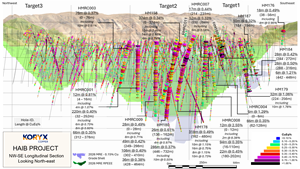
Long section showing fifteen drillhole intersections relative to the model for CuEq% Intercepts
Legal Disclaimer:
EIN Presswire provides this news content "as is" without warranty of any kind. We do not accept any responsibility or liability for the accuracy, content, images, videos, licenses, completeness, legality, or reliability of the information contained in this article. If you have any complaints or copyright issues related to this article, kindly contact the author above.
